I must have been four or five years old the first time I remember it clearly.
I tried on one of my mum's dresses and a pair of her heels.
At that age I didn't know anything about gender identity. I certainly didn't know words like transgender or dysphoria. There was no grand revelation and no way a child that young could have understood what those feelings might eventually mean.
I just knew how it felt.
It felt right.
That's the part that has stayed with me. It wasn't something that suddenly appeared in adulthood, nor something I discovered after reading about gender identity on the internet. Some of my earliest memories already contain it.
As I got older, I would secretly try on my sister's clothes too. It had to be done quietly because I already understood one of the rules the world had handed me: boys didn't wear girls' clothes.
What I didn't understand was why wearing them made me feel so good. There was nothing sexual about those childhood experiences. I was four or five years old. It was simply a strange sense of recognition, long before I had the vocabulary to recognise what I was recognising.
The problem wasn't that it took me nearly fifty years to realise something was different. I knew. I simply didn't have the words for it.
Trying harder to be a man
As I grew older, those feelings didn't disappear. I became very good at pushing them somewhere else.
I did what many people do when there's something about themselves they don't understand, or don't believe they are allowed to be. I ran in the opposite direction.
If part of me felt feminine, perhaps the answer was to become more masculine.
So I tried.
I threw myself into things traditionally seen as male: cars, motorbikes, machinery, tools, getting dirty and fixing things. The funny thing is that none of those interests were false. I still love them. Accepting the feminine part of myself hasn't suddenly made me dislike engines, cameras or getting covered in oil while trying to repair something.
There was never anything wrong with those parts of me. The mistake was believing they somehow proved that the other part couldn't possibly be real.
For years I seemed to be collecting evidence of masculinity, hoping that if I gathered enough of it, the inconvenient feelings would finally disappear.
They never did.
The wardrobe door never stayed shut
The dressing continued, sometimes frequently and sometimes with long gaps in between.
There would be periods when I convinced myself I was finished with it. Clothes would be put away or thrown out. I'd tell myself that was it, that I needed to stop and get on with my life.
Then eventually the feelings would return. And so would the clothes.
It became a cycle. What I didn't realise at the time was that I wasn't really fighting a wardrobe. I was fighting myself.
Relationships made everything considerably more complicated. It's one thing trying to understand your own feelings. It's another trying to explain them to somebody you love when you barely understand them yourself.
Previous partners couldn't cope with it. The dressing was difficult enough. Wanting my body to change was something else entirely.
I can understand why that raised frightening questions. What did it mean for them? What did it mean for the relationship? Where would it end?
The trouble was, I couldn't answer those questions either.
Growing up without the words
Looking back, one of the frustrating things is knowing that the signs weren't particularly subtle. I didn't suddenly discover this side of myself in middle age. I can trace it back to some of my earliest memories.
What I lacked wasn't the feeling. I lacked the language.
And later, when I began to understand more, I lacked the support.
The world I grew up in was different. There weren't endless first-person accounts a few clicks away, and there certainly wasn't the sense that you could simply tell somebody what you were experiencing and expect them to understand.
So I adapted. I hid it. I tried to suppress it. I tried being more masculine. I entered relationships and hoped perhaps this time the feelings would finally disappear.
When they didn't, I spent far too long treating the feelings themselves as the problem.
Then I met someone who didn't run away
My wife knows. More importantly, she understands.
That doesn't mean every aspect of this journey is effortless, or that there haven't been conversations, questions and uncertainties. But I haven't had to hide Brianna from her.
There is something enormously liberating about that. When you've spent years monitoring yourself, hiding clothes, suppressing feelings and wondering what would happen if somebody really knew you, simply being able to exist without constantly watching over your shoulder changes things.
Gradually, the question stopped being, “How do I make this go away?”
It became, “What if it isn't supposed to go away?”
Crossing a line
Eventually, clothes weren't enough. I wanted my body to change.
Around five years ago, I began taking feminising hormones myself, without medical supervision. DIY HRT isn't something I'm presenting here as advice or recommending to anybody else. It is simply part of my story.
There were physical changes, of course, but there was something else too. For the first time, I wasn't merely dressing a male body differently. My body itself was beginning, slowly, to move towards something that felt more like mine.
That distinction became enormously important.
There have been starts and stops over those years, along with doubts and practical questions about health, relationships, money and what I actually wanted from all of this.
But one thing became increasingly difficult to deny: I didn't want to go backwards.
Where I am now
I don't necessarily want to spend every waking moment presenting to the world as a stereotypical woman. That's never really been what this is about for me.
I can still be the person in the garage working on a car. I can still get excited about cameras. I can still wear whatever I want. I don't have to exchange one box for another.
What I want is for my body to feel right to me.
After roughly five years of navigating HRT myself, I'm now seeking proper medical supervision. I want specialists involved, the appropriate monitoring, and ultimately I want to pursue the surgeries that I hope will bring my body closer to the one I've imagined for so many years.
Writing that publicly still feels rather enormous. Inside my own head, though, this conversation has been going on for decades.
Not a late discovery
I'm approaching fifty now, but this isn't really a story about discovering who I am at nearly fifty.
The child standing in his mum's dress and heels didn't need another four decades to discover that something was there. In a strange way, he already knew. He simply didn't have a name for it.
What followed were decades of hiding, questioning, trying to conform, trying to make relationships work, and repeatedly discovering that this part of me wasn't going anywhere.
Today I finally have the vocabulary that child didn't have. I have an understanding and supportive wife. And I'm reaching the point where I can seek the medical help and changes that simply weren't available to that little four or five-year-old trying to make sense of why a dress and a pair of heels felt so unexpectedly right.
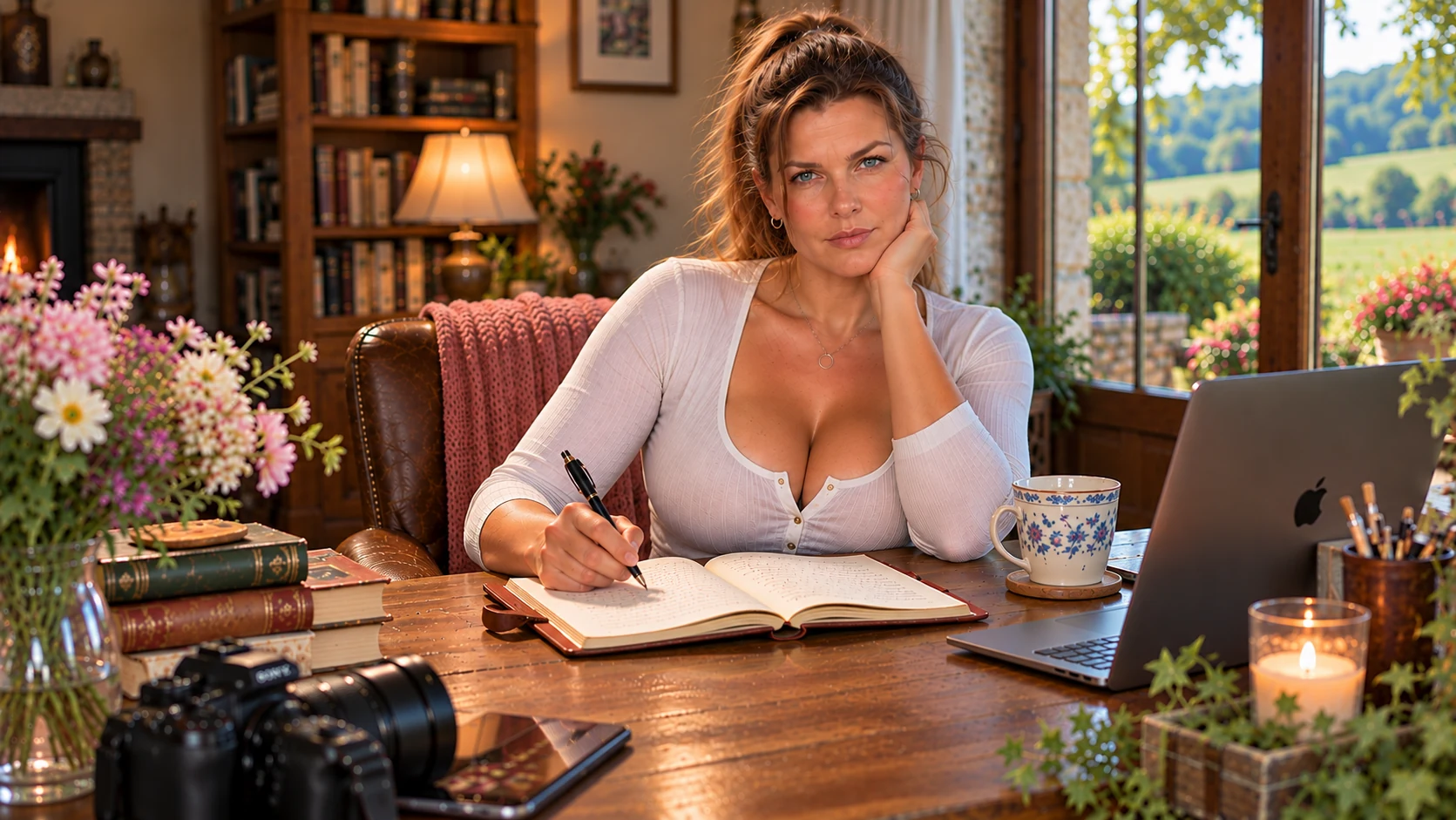
The images of Brianna throughout this website are AI-generated from my own appearance, feminising my features to visualise the woman I see in myself. I'm not pretending they are ordinary photographs of how I look today. They're a glimpse of possibility, an aspiration rather than a claim of reality.
And when I look at her, there is something very familiar looking back.
Maybe that's because Brianna isn't somebody I've just discovered. She's somebody I've finally stopped trying to make disappear.